• Saginaw Zoo
  • Saginaw Zoo
  • Saginaw Zoo
  • Saginaw Zoo
  • Saginaw Zoo

Latest Events

Don't "Fry" Day
Fri, May 24, 10:00am - 2:00pm
World Oceans Day
Sat, Jun 8, 10:00am - 2:00pm
Father's Day
Sun, Jun 16, 10:00am - 5:00pm
DEAR at the Zoo (Drop Everything and Read)
Wed, Jun 19, 10:00am - 3:00pm
Brew at the Zoo
Thu, Jun 20, 6:00pm - 9:00pm
Fun on the Farm
Tue, Jul 9, 10:00am - 2:00pm
AZAlogo
glbrlogo
Join our mailing list to keep up-to-date and receive Zoo Newsletters!


Email Marketing by VerticalResponse
TrailersHut.com

Animal Encounters Print E-mail

The Children’s Zoo features a variety of animals ranging from small insects to our large Clydesdale Horses. We are currently home to over 150 animals (and that’s not including the thousands of insects!) year round.

While visiting the Zoo, you may run in to a few of our feathered friends walking the beautiful gardens and walkways. Peacocks and peahens roam our Zoo grounds and make sure to watch for those waddling ducks around the large pond.

Be sure to take part in our hands-on experiences with our hoof stock yards which include a llama and alpaca, alpine goats, cows and sheep. Oh, and let’s not forget the little pot-bellied pig who rules it all.

Our black-footed penguins will wow you with their amazing speed and grace as they glide effortlessly through the water. The capuchin monkeys will make you laugh (or duck) as they search for the tasty treats the keepers have hidden in their exhibit. Or perhaps you would prefer to take a walk-a-bout through our eastern grey kangaroo exhibit. One may even hop across your path! Enjoy the colors and fragrances of the breathtaking gardens as you stroll along our paths and through our colorful butterfly house. 

Mammals

Two main characteristics of mammals are that they are endothermic (warm-blooded) and have vertebrae (having a backbone). However, these characteristics are not only unique to mammals. Other animals which are not mammals can also have these characteristics. One trait that makes mammals unique is the presence of mammary glands, with which mothers produce milk to feed their young. The word "mammal" is derived from this characteristic. Mammals give birth to live young, with the exception of egg-laying monotremes (platypus and echidna). All mammals develop fur at some point during development, but not all keep it throughout their lifespan. Mammals have one main jaw bone which attach directly to the skull, unlike other animals which may have many bones comprising the jaw that may not attach to the skull.  Mammals are also unique in that they have only one primary artery leading to the heart, while other animal groups can have many. 

Serval silhouetteWolf silhouetteClydesdale silhouetteKangaroo silhouette

                          Alpaca        
Llama
Alpine Goat Miniature Donkey
Black-tailed Prairie Dog Miniature Horse
Bobcat Miniature Zebu
Clydesdale Horse North American River Otter
Coatimundi Pot-bellied Pig
Cotton-Top Tamarin Romney Sheep
Domestic Donkey Striped Mice
Eastern Grey Kangaroo Scottish Highland Cattle
Flemish Giant Rabbit Serval
Grey Wolf Sugar Glider*
Holstein Cattle White-throated Capuchin
Jersey Cattle

Birds

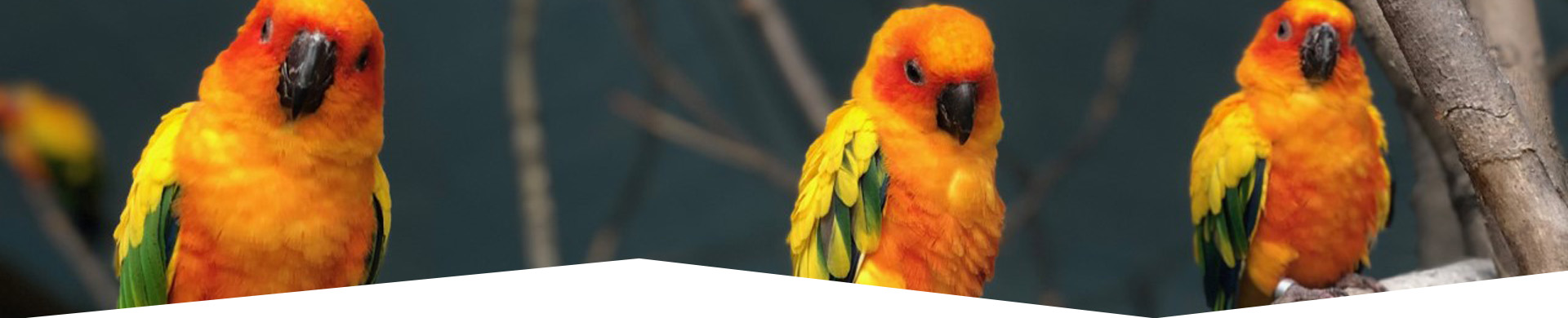
Birds are also endothermic, vertebrate animals. All birds are egg-layers, and although not all birds are born with feathers, all eventually develop feathers. Not all birds can fly, but those that can have specialized feathers, bone structures, and muscle mass which give them this ability. Birds do not have jaws with teeth. Instead, they have lightweight beaks or bills, and the shape of the beak or bill varies based on the type of food the bird consumes.

Peacock silhouettePenguin silhouetteCockatoo silhouetteEagle silhouette

American Crow   Eclectus Parrot
Bantam Chicken*   Emu
Bald Eagle  Moluccan Cockatoo
Black-footed Penguin Military Macaw
Blue and Gold Macaw Orpington Chicken
Campbell Duck   Patagonian Conure
Cockatiels Peafowl
Dominique Chickens Sulphur-crested Cockatoo
Domestic Ducks Umbrella Cockatoo


Reptiles

Reptiles are ectothermic (cold-blooded), vertebrate animals. They regulate their body temperature by either seeking or avoiding the sun’s heat. There are five main groups of reptiles which include: turtles and tortoises, lizards, snakes, crocodiles and alligators, and tuatara. Reptiles have scaly skin which helps to keep their body’s moisture in. They are mostly egg layers, but there are a few species that have live birth. Mothers who lay eggs generally leave the nest once the eggs are laid, leaving the hatchlings to fend for themselves.

Lizard silhouetteTortoise silhouetteAlligator silhouette

American Alligator      Leopard Gecko 
Blue Spiny Lizard
    Leopard Tortoise
Boa Constrictor
      Red-eared Slider
               Central American Wood Turtle*                         Royal Python*
Green Anole         White-throated Mud Turtle
Hinge-back Tortoise*

Amphibians

Amphibians are also ectothermic, vertebrate animals. They too rely on their environment to regulate their body temperature. Amphibians can be broken down into three main groups: salamanders and newts, frogs and toads, and caecilians. Most have soft, moist skin and tend to live in moist places or near water. Amphibians absorb nutrients and moisture through their skins. Because of this, amphibians are among the first to suffer in areas with air and water pollution. They can live on land and in the water. Amphibians experience a developmental process called metamorphosis meaning they start as small larvae that then begins to morph and change in body shape, changing their diet and lifestyle.

Frog silhouetteCattailFrog silhouette

Invertebrates

Invertebrates are animals that do not have a backbone. There is a wide range of species that are classified as invertebrates, but besides the lack of backbone, not much else is shared. Invertebrates make up around 97% of the world! Invertebrates can be found in almost any habitat including forest, desert, and the ocean. Invertebrate groups include spiders and scorpions (arachnids), insects, worms, centipedes, snails, clams, mussels, jellyfish, squid, crabs, and sea stars, just to name a few.

Cockroach silhouetteTarantula silhouette

Chilean Rose Tarantula Madagascar Hissing Cockroach
Hermit Crab
Florida Millipede
Honey Bee
Zebra Leg Tarantula


* Animals are not on exhibit. They are used for educational programs only.

 **All animal information is meant to be an educational resource. It may not include all the latest scientific information. Though we edit our information we cannot guarantee the accuracy of all facts presented.